Choose a picture
Save one photograph for the first six days. Pick an image you can look at closely.
Open a different kind of door each day. You’ll find six ways to read a photograph, six kitchen puzzles, six listening games and six small steps toward a story worth telling on Christmas Eve.
Use the free template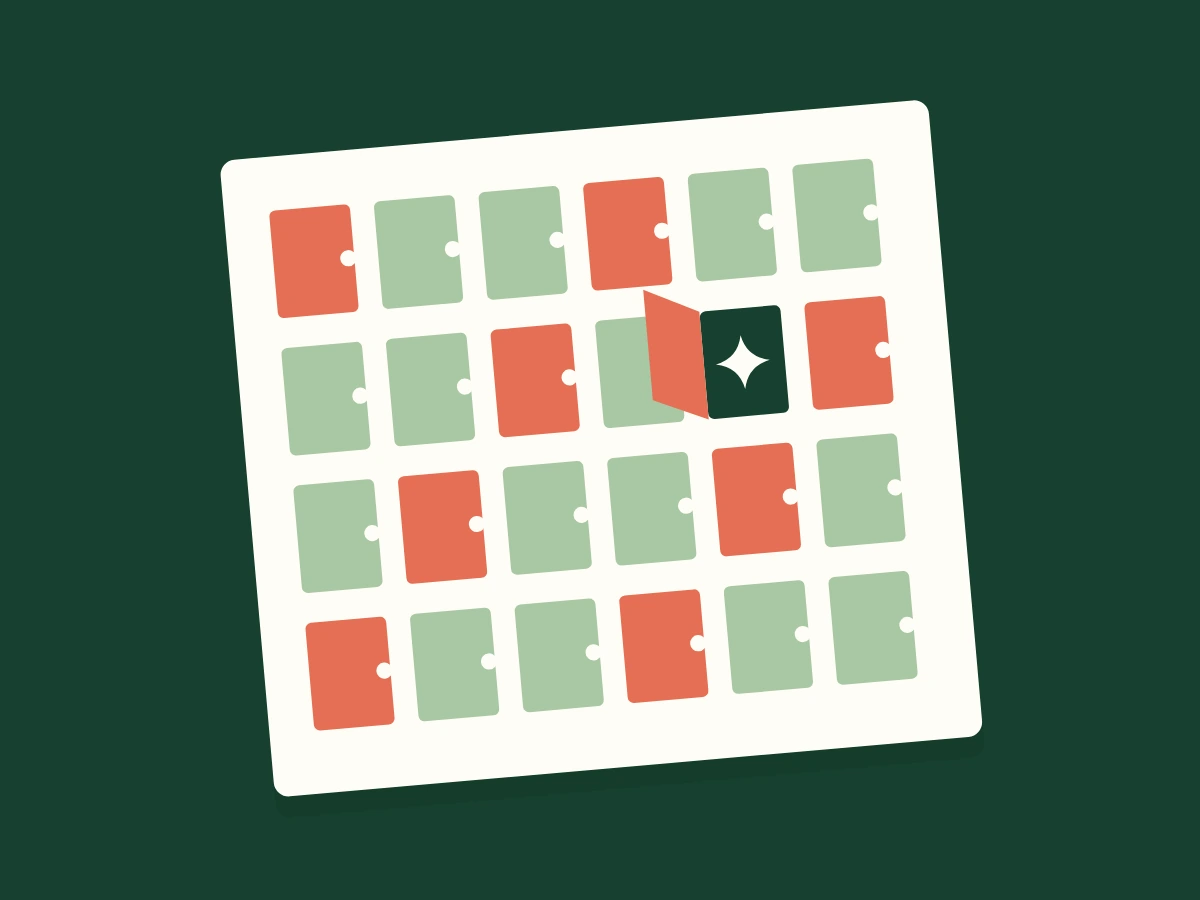
On December 1, pick a photograph and cover its caption. What can you actually see? What have you quietly supplied yourself? Two wet umbrellas are visible. Whether the wedding guests were miserable is a much better question to ask someone who was there.
That’s the whole idea of this Advent calendar. Every day has one thing to try and a way to look or listen again. Use it yourself or send one activity a day to someone who likes a puzzle. The kitchen answers are tucked below the six questions.
The method
You can use the dates as written or start with whichever activity suits today.
Save one photograph for the first six days. Pick an image you can look at closely.
Try the six kitchen puzzles in the margin. Give yourself room to change an answer.
Pick a recording you like enough to replay. Save the track so you can return to the same version.
Look for one object with a story. Keep its name a surprise if someone is doing the last six days with you.
Pick a photograph from your camera roll or a postcard. A blurry corner or a crooked row of chairs can give you more to investigate than a perfect portrait.
National Archives guide to reading a photograph
A pencil is all you need for these invented kitchen puzzles. Try each one before you unfold the answers.
Choose a familiar recording. A carol, a film theme or the song that always gets played while someone washes up will do.
Find an object you could hold up at the table. A chipped cup, a bus ticket or a bent key works if you remember how it came to you.
Which day made you go back for a second look? We built WiseTom for questions like that. If you kept replaying a bass line, try “Help me follow the bass when I listen to a jazz trio.” If the photograph stayed with you, try “Help me read an old family photograph and work out which details I can check.”
You can also keep going with just the calendar. Try the photograph questions on a picture taken by someone else, then compare the clues each photographer left in the frame.
Free calendar
Download the calendar to print, fold into slips or share one date at a time. Keep the kitchen answer key for the person handing out the slips.
Download the calendar (.txt)The WiseTom learning Advent calendar December 1 to 6 · Look closer at one photograph Dec 1. Hide the caption. Write down three things you can point to. “Two wet umbrellas” counts. “A miserable afternoon” is a guess you can test. Dec 2. Visit the edge. Cover the center with your hand. Find one detail at the edge that changes what you think was happening. Dec 3. Listen to your guess. Write “perhaps” before one claim about the people. What would you need to ask the photographer to be sure? Dec 4. Crop a different story. Frame the same picture two ways with your fingers. Give each crop a title. Which missing detail changes the story? Dec 5. Find the photographer. Look for a reflection, a shadow or a line of sight that hints at where the camera stood. If there is no clue, draw two possible positions. Dec 6. Read the caption. Reveal it, or ask the person who took the photo. Mark one guess it supports and one question it still leaves open. December 7 to 12 · Play with kitchen numbers Dec 7. Invite two more. A recipe uses 180 grams of rice for three servings. How much would you measure for five equal servings? Dec 8. Wrap the leftovers. Your roll of paper is 3 meters long. You cut four strips of 60 centimeters. Is there enough left for a fifth? Dec 9. Split the shopping. One pack of cocoa costs 4 coins for 200 grams. Another costs 6 for 250 grams. Which costs less per 100 grams? Dec 10. Time the biscuits. A batch goes in at 3:48 and needs 17 minutes. What time should you check it? Dec 11. Deal twelve cookies. Give one person half the batch and another a third of the original batch. How many of the twelve are left? Dec 12. Rebuild the recipe. You used 300 grams of rice for five people. Work back to the quantity for the original three, then explain your method in one sentence. December 13 to 18 · Borrow a song you know Dec 13. Catch the pulse. Tap along to a short passage. Keep tapping when you turn the volume down, then turn it back up and see where you land. Dec 14. Follow one sound. Choose the lowest sound you can pick out. Hum a few seconds, replay them and listen for the spot where your version wandered. Dec 15. Spot the entrance. Pick a moment where a new voice or instrument joins. Write down the time so another listener can find it. Dec 16. Draw the tune. Trace the rise and fall of one sung line with a finger. Replay it and check the direction of the final two notes. Dec 17. Change one thing. Clap a short pattern twice, then change only the last clap. See if a friend can point to the change, or record and listen back yourself. Dec 18. Be the DJ. Introduce the track in one sentence that tells someone when and what to listen for. Play that moment and see if your clue works. December 19 to 24 · Tell a small true story Dec 19. Choose the object. Describe it without naming it. Which detail would let someone pick yours out of a drawer? Dec 20. Name a moment. Finish “I remember the day this…” with something that happened in one place. Read it aloud and picture the scene. Dec 21. Ask a better question. Trade “Did you like it?” for a question that invites a detail. Try “What did you do with it first?” Dec 22. Find the turn. Put the events into two sentences joined by “until.” What changed after that word? Dec 23. Try it on a listener. Tell the story in half a minute. Ask which detail they remember. Alone? Record it and listen for the detail you would keep. Dec 24. Write the label. Give the object a two-line museum label with one detail you can see and one part only you could tell. Read it to someone or tuck it beside the object. Kitchen answer key December 7. Each serving uses 60 grams, so five take 300 grams. December 8. Yes. The roll is 300 centimeters. Four strips use 240, leaving exactly 60. December 9. The first costs 2 coins per 100 grams. The second costs 2.4. December 10. At 4:05. Twelve minutes take you to 4:00 and five more to 4:05. December 11. Two cookies remain after you give away six and four. December 12. Divide 300 by five to get 60 grams per person. Three servings take 180 grams.
Put it into practice
A song, a picture or a puzzle can be the start of a whole course. Tell WiseTom what you want to understand next.


Want new features first?
Questions
The calendar and all 24 activities are free. Use a photograph, something to write on, a recording you can play and an object you already own.
Yes. Pick today’s activity or start with a group of six that sounds interesting. Each group works independently.
Print the text file, cut out the dates, and fold the activities into envelopes. You can also send a single date as a message each morning. Keep the kitchen answer key until the recipient wants to check.
Yes. Try the same photograph or recording separately and compare what you noticed. For the last six days, each person can bring an object and trade stories.
See it in concrete terms
Pick a subject that made you curious this December.
Take better phone photos by understanding light, framing and focus.
Hear the structure inside a jazz performance and know what to listen for.
Make a point through a specific, truthful story.
Method
We wrote original activities around four things people can find at home. The National Archives photograph worksheet informed the distinction between a visible detail and an interpretation. The kitchen puzzles use invented quantities.
Limits of this review: Activities are open-ended except for the six arithmetic questions, which have worked answers.

Try WiseTom today
Bring your favorite December question to WiseTom on iPhone or Android.
Want new features first?